The Instruction Trap: Why You’re Paying for the Same Lesson Twice

And what becoming a student of the game actually looks like
You know the feeling. The lesson ends and something finally clicks. On the drive home, you’re mentally replaying the move, already imagining Saturday’s round. You can see the new ball flight off the tee.
You think to yourself...this next round is going to be a game changer...then Saturday arrives. And so does your old swing. What happened?
If you’ve ever wondered why golf progress feels so disproportionate to the time and money you invest, the answer isn't what you think. It’s not a lack of athleticism. It’s not a lack of commitment. It’s not even a "bad" instructor.
It’s your working memory. And nobody told you how to make it work in your favor.
This "hidden ceiling" is why you’ve spent thousands on instruction only to find yourself grinding over the same faults year after year. To break through, you don't need a more complex swing; you need to understand the hardware running it.
The Science of the "Mental Workspace"
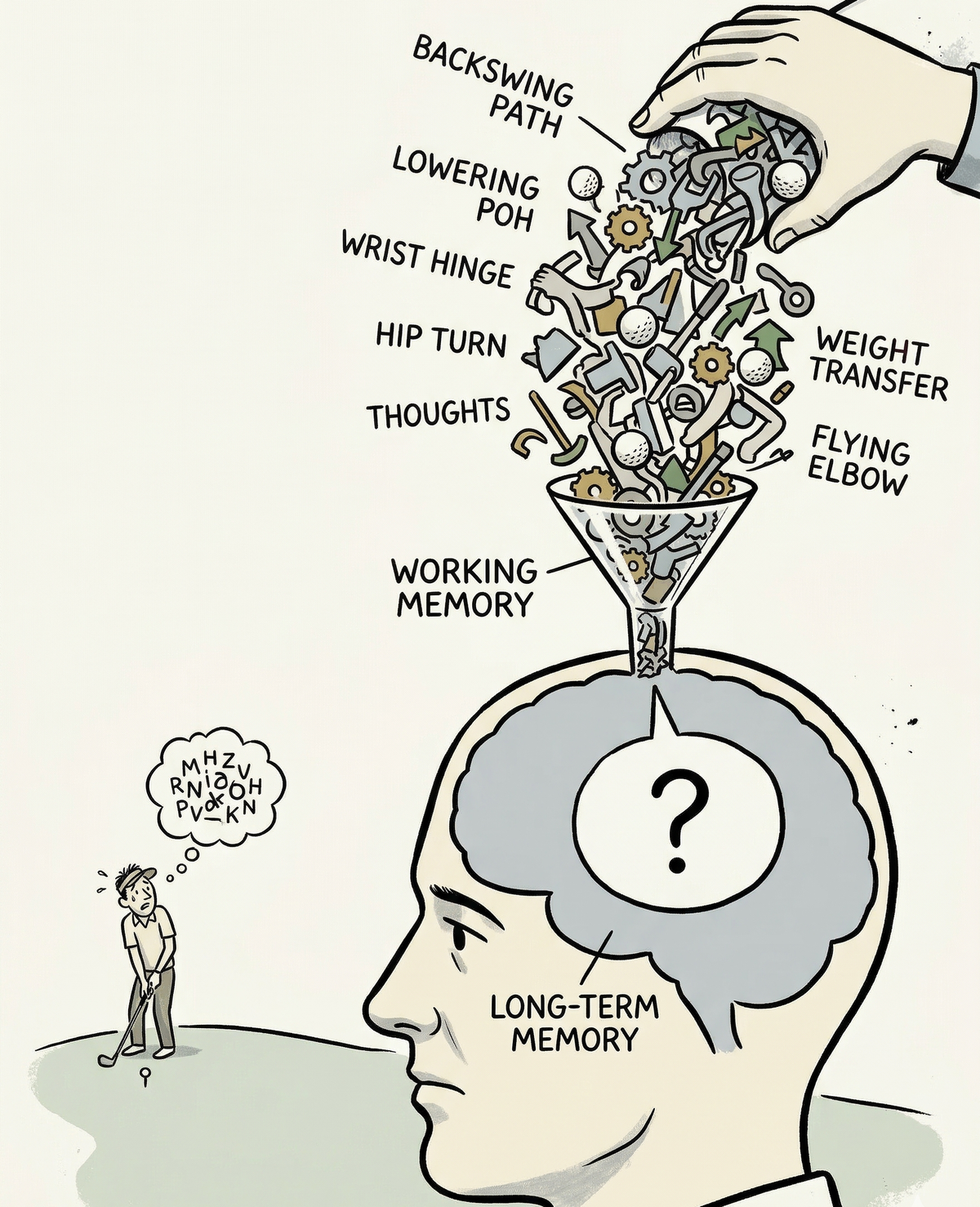
In the late 1980s, educational psychologist John Sweller discovered the core architecture of human learning: Cognitive Load Theory. Our brains operate with two distinct systems. Working memory is your mental workspace, the "RAM" where you process new info in real-time. It is notoriously small. Most people can only handle three or four new concepts before the system buckles. This is why we need to make lists for the grocery store.
Long-term memory, where ingrained skills eventually live, is essentially unlimited. But to get a new swing thought from your "RAM" into your "Hard Drive," you have to give the idea enough space to land.
When working memory is overwhelmed, learning doesn't just slow down. It stops. You could spend 60 minutes in a lesson and hardly have anything to show for it if your working memory is overwhelmed early.
The "Jake" Trap
Consider "Jake" (a successful professional, mid-forties, mid-eighties shooter.) He has the fitted clubs and the desire, but he’s never broken 80 despite all the effort.
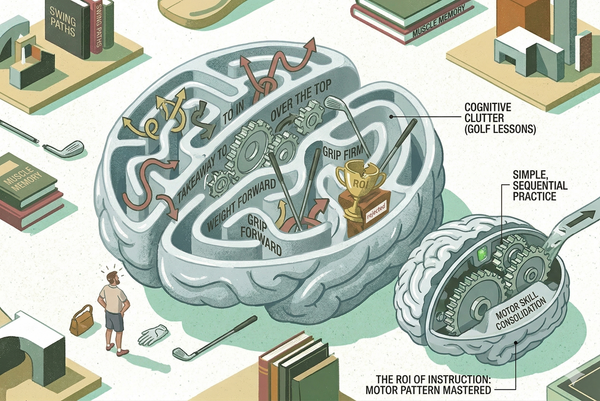
During a recent lesson, his coach correctly identified four flaws: an inside takeaway, a flying trail elbow, a stalled weight transfer, and a lost spine angle. Jake tried to manage all four simultaneously.
His swing became rigid and mechanical. This is exepectd when the brain is hanging onto all of these thoughts. His brain had run out of processing power. The information had nowhere to go. Two weeks later, he was right back where he started.
The Culture of "More"
Golf instruction often rewards thoroughness. A coach who spots five things feels more "expert" than one who focuses on one. We’ve been conditioned to think more feedback equals more value.
Cognitive Load Theory proves the opposite. When you’re absorbing a genuinely new motor skill, like a different grip pressure or a new hip sequence, your working memory is already under strain. Layering three more concepts on top doesn't triple the learning; it prevents it from happening entirely.
How to Be a Smarter Student of the Game
Becoming a "Smarter Student" means managing your own cognitive load. It’s about demanding a different kind of instruction:
- The Power of One: Effective learning happens when attention is narrowed. If you leave a lesson with more than one technical thought, the lesson might have been well-intentioned, but it was poorly designed for your biology.
- The "Conversation Test": A new movement pattern is only "learned" when it becomes automatic. You’ll know you’re there when you can execute the move while holding a casual conversation. Until then, don't add a second layer.
- Feel Over Mechanics: Mechanical thoughts (angles, positions) heavy-load the brain. Sensation-based cues (what the move feels like) bypass the bottleneck and move to long-term storage faster.
The biggest upgrade available to you isn't a new driver or a "miracle" swing tip. It’s a fundamental shift in how you acquire skill. When you respect the limits of your working memory, you stop practicing for "activity" and start practicing for mastery.