What Do Justin Rose and Novak Djokovic Know That You Don't?

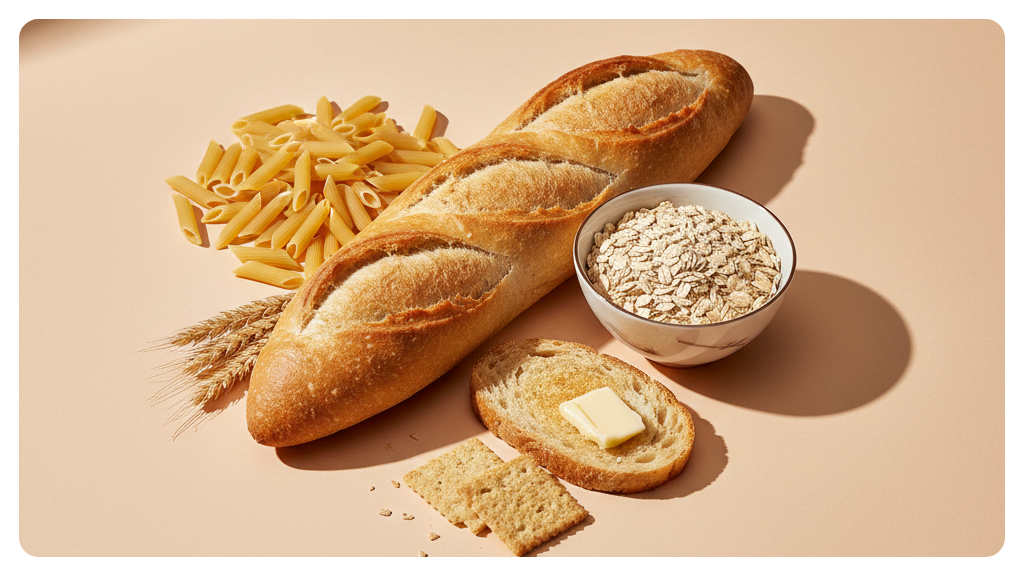
The real reason elite athletes go gluten-free — and why it has almost nothing to do with weight loss.
There's a question worth sitting with before we get into the science.
Justin Rose is 44 years old, holding the 36-hole lead at the Masters, outdriving men half his age, and traveling to every tournament with a custom recovery room — a stripped-down RV fitted with cold plunges, an infrared sauna, and a steam shower. Novak Djokovic, a man who once cramped and retired mid-match, has spent the last decade rewriting the record books for tennis longevity. He is, by almost any measure, the greatest tennis player who ever lived.
Both men went gluten-free. Both men transformed.
So here's the question we should actually be asking: What is it about this dietary choice that keeps attracting the most disciplined, most analytically rigorous competitors on the planet?
Because elite athletes are not trend-followers. They are ruthless experimenters. They discard what doesn't work. They keep what moves the needle. And when two icons from completely different sports, training backgrounds, and coaching philosophies land on the same dietary intervention — and then sustain it across decades — that's a signal worth taking seriously.
The Athlete's Real Currency: Recoverability
Here's the frame that changes everything.
The casual observer looks at elite sports and sees performance — the drive down the fairway, the backhand winner, the clutch putt. What elite athletes actually obsess over is something less visible: how fast can I get back to full capacity after I've been taxed?
This is recoverability. And it is the single most underrated variable in long-term athletic success.
Talent gets you to the tour. Recoverability keeps you there.
Think about what separates the career of a Justin Rose from someone with equal ball-striking ability who peaked at 30 and faded. It's not the swing. It's the ability to play 25 weeks a year, absorb the physical and cognitive load of tournament golf, travel across time zones, and still show up sharp on Thursday. Week after week. Year after year.
The gluten-free diet, for people sensitive to it, is fundamentally a recoverability intervention. Not a performance drug. A friction reducer. And friction reduction, compounded over a career, is the difference between longevity and premature decline.
Why Gluten Specifically? The Inflammation Connection
To understand why elite athletes keep arriving at this particular intervention, you have to understand what gluten does in the body of someone with sensitivity — and how common that sensitivity actually is.
Gluten is a protein found in wheat, barley, and rye. For people with celiac disease, it destroys the intestinal lining. But celiac is relatively rare. What's far more common — and far more relevant to performance — is a spectrum of non-celiac gluten sensitivity that researchers are only beginning to map.
Here's what happens in the gut of a sensitive person after gluten exposure:
The gut lining, which acts as a selective barrier, becomes temporarily more permeable. Proteins that should stay inside the intestine leak into the bloodstream. The immune system — doing exactly what it's designed to do — identifies these proteins as foreign and mounts a response. That response is inflammation. Not dramatic, symptomatic inflammation. The quiet, systemic kind that you feel as stiffness, brain fog, sluggish recovery, and disrupted sleep.
Rose described his pre-intervention state perfectly without knowing it: joints that ached in the morning, a body that felt like it was fighting itself. That's not age. That's inflammation tax. Remove the trigger, and the body stops fighting itself and starts recovering instead.
The Part Nobody Reports: It's a Cognitive Performance Story
Weight loss makes headlines. The real story is harder to see.
When Djokovic went gluten-free, the change the world noticed was physical — he looked leaner, moved better, cramped less. But the change that actually mattered was neurological.
Your gut and brain are connected through what scientists call the gut-brain axis — a communication network running through the vagus nerve that transmits signals bidirectionally. When your gut is inflamed, your brain receives distress signals. The downstream effects include reduced working memory, shortened attentional focus, lower emotional regulation, and decreased stress tolerance.
For a tennis player, that means unforced errors when the match tightens. For a golfer, it means the wheels coming off on the back nine — not because your swing broke down, but because your nervous system ran out of bandwidth to manage it.
Djokovic's legendary composure in the fifth set — his ability to stay tactically sharp and emotionally regulated when opponents are wilting — is widely attributed to mental toughness. Mental toughness is real. But it operates on a substrate. That substrate is a nervous system that isn't being taxed by chronic gut inflammation.
When you reduce that inflammatory load, you don't become a different competitor. You become a less-impeded one. And at the elite level, less impediment looks like superhuman consistency.
The Longevity Factor: Why This Choice Compounds Over Time
Here's what makes the gluten-free choice particularly intelligent from an athlete's perspective: its benefits compound.
A single week of reduced inflammation doesn't transform you. But a year of marginally faster recovery, slightly better sleep, reduced joint stiffness, and cleaner cognitive function adds up to something measurable. Then a decade of it.
This is exactly why the pattern of elite adoption is so telling. Athletes who make this switch rarely abandon it. Not because they're dogmatic about diet, but because the feedback loop is clear: remove the friction, perform better, recover faster, feel the difference.
Rose has maintained this approach for years and is still competing at Augusta at 44. Djokovic, at 37, continues to add Grand Slam titles. These aren't coincidences. They're data points.
The question worth asking isn't "is this a fad?" The better question is: why do the most data-driven athletes on the planet keep choosing this?
The answer is that they've learned to treat their bodies as systems that either compound toward capacity or erode toward limitation. Every dietary choice is either adding signal or adding noise. Gluten, for many of them, turned out to be noise.
The Selection Effect: Who Discovers This, and Why
There's one more layer to this that rarely gets discussed.
Elite athletes don't stumble into dietary interventions. They arrive at them through a rigorous, often expensive process of experimentation — working with sports nutritionists, monitoring biomarkers, tracking sleep and recovery data, and paying close attention to how their body responds to different inputs.
Most recreational athletes don't have access to that infrastructure. Which means the insights elite athletes accumulate through years of personalized performance testing stay largely invisible to everyone else.
The gluten-free finding is one of those insights that has quietly circulated among elite performers across sports for years. Djokovic's book brought it into the public conversation. Rose's longevity keeps it credible. But neither of them is the first, and they won't be the last.
What they've done is validate a hypothesis that a growing body of research supports: for a meaningful percentage of athletes, chronic low-grade gut inflammation is a hidden ceiling on performance. Not the only ceiling. But a real one.
And unlike most performance ceilings — which require years of technical refinement to raise — this one can be addressed in 30 days.
So Is It a Key Contributor to Their Success?
Here's an honest answer: it's impossible to isolate a single variable in the career of an elite athlete.
Rose's success comes from elite ball-striking built over decades, a short game refined through thousands of hours of practice, mental frameworks developed with world-class coaches, and a competitive temperament that was his before he changed a single thing he ate.
Djokovic's dominance is rooted in movement patterns, tactical intelligence, and serve development that have nothing to do with his gut.
But success, at the highest level, is rarely the result of one thing. It's the result of removing every removable obstacle — and then compounding those small advantages over time. The gluten-free diet is not what made Justin Rose or Novak Djokovic great. It's what allowed their greatness to sustain.
That's a different and more important claim. Because it's the one that applies to you.
You're probably not competing for a Green Jacket or a Grand Slam. But you are competing against your own ceiling — the gap between what you've built in practice and what you can actually access on the course when it counts. If chronic, invisible inflammation is quietly taxing your recovery, your focus, and your emotional regulation, then you're playing with a handicap you don't even know you have.
That's worth a 30-day experiment to find out.
The Experiment
You don't need a doctor, a nutritionist, or a lab test to start. You need a decision and a notebook.
For 30 days, eliminate gluten completely. No wheat, barley, or rye. Eat whole foods: rice, potatoes, vegetables, fruit, meat, fish, eggs, legumes, nuts. Read labels — gluten hides in sauces, soups, and processed foods.
Track three things each morning: energy (1-10), joint stiffness (1-10), mental sharpness (1-10). Do this for two weeks before you start, so you have a baseline.
Then watch what happens on the course. Not to your swing. To your staying power — your focus at 16, your emotional reset after a double, your energy in the final stretch of a competitive round.
That's the data Rose and Djokovic have. Now you can run the same experiment.
UnBogey exists to close the gap between what elite performers know and what the rest of us are taught. If this article landed, share it with a golfer who's still looking for their ceiling.