Scottie Scheffler's Real Opponent This Week Is His Own Nervous System
 Piers Blyth
5 min read
Piers Blyth
5 min read
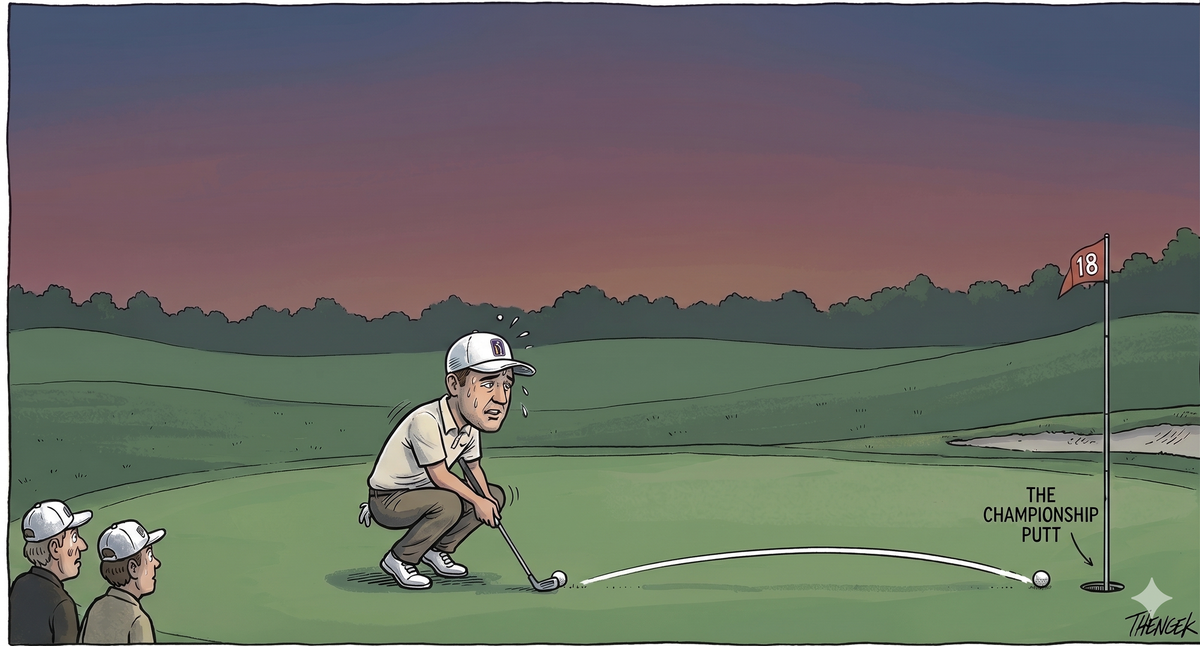
The Memorial asks for precision at the exact moment pressure takes it away. The neuroscience of a three-peat.
Scottie Scheffler arrives at Muirfield Village this week as the world's best player, the two-time defending champion, and the betting favorite to do something only Tiger Woods has done here: win the Memorial three years running. The last man to three-peat any event on the PGA Tour was Steve Stricker at the John Deere, fifteen years ago. It's rare air, and the number that should worry Scheffler isn't on the leaderboard. It's the one his body produces when the moment gets heavy.
Here's the strange part. Scheffler hasn't won since January. He finished second at the Masters, stacked up more runner-ups through the spring, and took solo third at the Byron Nelson two weeks ago. The most expected man in golf keeps reaching Sunday afternoon and not closing. That's not a swing problem. A swing that good doesn't disappear. It's a question about what expectation does to a human nervous system, and Muirfield Village is the cruelest possible place to ask it.
A course built to punish the thing pressure breaks
Start with the test itself. Jack Nicklaus's design forces players to hit more than half their approach shots from beyond 175 yards, into greens that run about 5,000 square feet and roll past 13 on the Stimpmeter. Miss those greens and you're in primary rough grown past four inches, a dense blend of bluegrass, ryegrass, and fescue that doesn't negotiate.
The geometry is unforgiving. A clubface open or closed by a single degree at impact starts the ball a few yards offline at 100 yards and more than a dozen yards offline at 190. Distance multiplies error. So Muirfield demands the tightest dispersion at the longest range, off the clubs that magnify the smallest mistake, with the heaviest penalty for the miss. It's a precision test at exactly the range where precision is hardest to hold. That matters, because the first thing the body sacrifices under pressure is fine motor control.
What the weight actually does
"The weight of expectation" sounds like a metaphor. It isn't. It's a cascade you can measure.
When the brain reads a situation as high-stakes, the amygdala signals the hypothalamus, the HPA axis fires, and the body floods with cortisol and adrenaline. Heart rate climbs. Breathing shortens. Blood routes to the large muscles. And in the hands, the system golf depends on most, a low-grade physiological tremor amplifies. Proprioception, your sense of where your limbs sit in space, gets noisier. None of that helps when you're trying to start a long iron on a line and hold it.
There's a sweet spot, of course. The Yerkes-Dodson curve holds that a little arousal sharpens performance and too much wrecks it, and the more delicate the skill, the lower the tipping point. Putting and wedge play tip first.
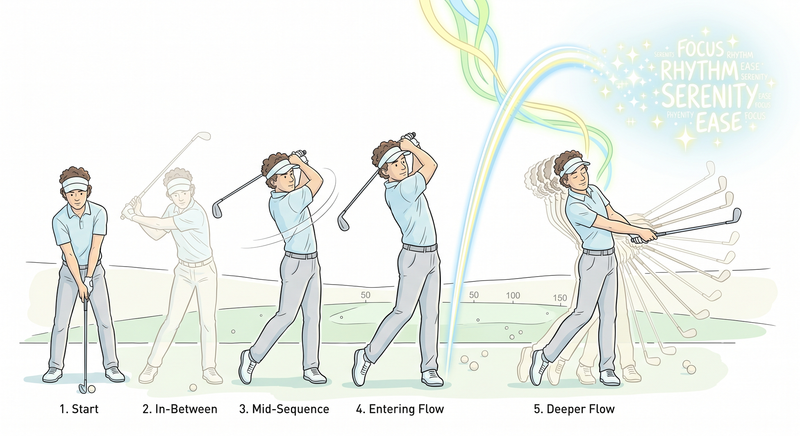
But the real saboteur for elite players is subtler, and it has a name. Researchers call it reinvestment, or explicit monitoring. An expert's swing is an automated motor program, run below conscious awareness, built over hundreds of thousands of reps. Under pressure, the conscious mind tries to grab the wheel. It starts supervising a motion that runs better unsupervised, breaking a fluid sequence into clumsy parts. Anxiety also narrows attention and shortens the "quiet eye," the steady gaze on the target that good players hold in the beat before they pull the trigger. The skill is all still there. The brain just stops letting the body use it cleanly.
Si Woo Kim had 59 in his hands
Two weeks ago you could watch this happen in real time. At the Byron Nelson, Scheffler's friend Si Woo Kim made 12 birdies through 17 holes and stood on the 18th tee needing a routine par for a 59, one of the rarest scores in the sport. Then he made his only bogey of the day and signed for 60.
The instructive part is Kim's own account. He said afterward he'd never been thinking about 59, that he was just trying to birdie every hole, right up until the 16th, when the number finally landed in his head. That was the moment the spell broke. With a perfect drive and a clean line on the last, he airmailed the green with a 6-iron, the kind of mistake a player of his caliber almost never makes from the fairway. Same swing he'd used 71 times that day. Different brain running it. The number became a load, and the load arrived through his hands.
Scheffler was in the same group, five shots back, watching the whole thing unfold. His description of his own round was telling. He said he focused on staying patient and letting the tournament come to him rather than chasing it. Two nervous systems, one fairway, opposite responses to the same kind of weight.
Equanimity is a skill, not a personality
That's the quiet case for Scheffler, and the reason the three-peat is live despite the drought. His swing isn't the prettiest on Tour and his footwork is famously chaotic, but his temperament is the most trained asset in golf. He's spent years narrowing the gap between the swing he owns on the range and the swing the moment will let him make. That gap is where tournaments are decided.
The good news for the rest of us is that it generalizes. The research points to a handful of levers any single-digit player can pull:
- Aim your attention outward, at the target and the shot shape, not inward at your mechanics. An external focus protects the automated motion from the conscious mind.
- Build a pre-shot routine and run it identically every time. It occupies working memory and crowds out the reinvestment.
- Take one slow exhale before the trigger to drop your arousal a notch off the top of the curve.
- Set process goals, not score goals, so the number never gets a chance to climb into your hands.
- Practice under manufactured pressure, with a putt to win or a few dollars on the line, so the nervous system has felt the heat before it counts.
Sunday
The forecast in Dublin is benign early, mid-80s and calm, the course at its most gettable. That only raises the bar: when everyone's making birdies, there's no cover for the man expected to win. By Sunday, storms move into the forecast and Muirfield will show its teeth.
If Scheffler completes the three-peat, the highlight package will credit the swing. The more honest story is that he'll have won the harder contest first, the one between the player he is and the chemistry that wants to make him someone else for four hours. The three-peat is a neuroscience problem dressed up as a golf tournament. Whether he solves it has less to do with his hands than with whether he can keep his mind from reaching for them.